
Sandéleh Alimentos has been in the market since 2005, headquartered in Sorocaba, in the interior of São Paulo state, with around 250 employees and more than 5,000 customers across Brazil and Latin America. Its product portfolio includes a mix of more than 10 families of preserved foods, packaged at its headquarters and distributed through its branches in Belo Horizonte, Rio de Janeiro, and Paraná. The company faced the challenge of ensuring production efficiency on the shop floor without losing the product quality the brand is known for.
Management and operators lacked the transparency needed to build and apply action plans that addressed the root cause of problems. After evaluating different market players, Sandéleh trusted Cogtive to deliver the visibility needed to drive plant results.
Here’s how that happened, in the Sandéleh and Cogtive success story.
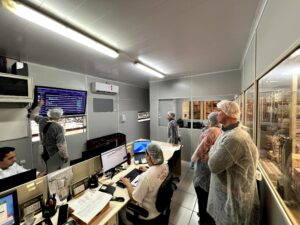
The challenge
Production faced a recurring collision problem on the equipment due to limited space on the conveyor, which put pressure on the grouping gate. Because of the excess pressure on the gate when it opened, more jars than necessary would pass through, causing collisions at the jar grouper. Monitoring showed the packaging machine was one of the line’s main stoppage points, especially because of the conveyor’s reduced space.
Even with a high-throughput machine, the conveyor didn’t have enough capacity to absorb the jars whenever small interruptions occurred. As a result, production was forced to stop because the conveyor couldn’t handle the flow of materials.
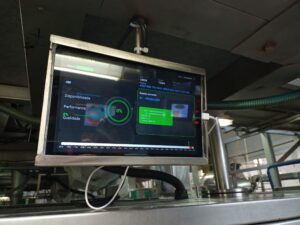
Downtime is logged digitally, and the data is displayed in real time on the Cogtive platform.
Implementing the improvements
To solve this problem, the team ran a detailed analysis and implemented a significant improvement to the conveyor. Before the optimization, the conveyor’s capacity was approximately 200 jars. After the changes, it increased to 560 jars, allowing up to five minutes of buffer time for technical adjustments before any line stoppage. That’s a capacity increase of around 180%.
In addition, the conveyor was redesigned to reduce pressure on the gate. Previously, all the pressure from jars accumulated on the conveyor was transferred directly to the gate, causing overload. With the new, more tapered configuration, that pressure is distributed more evenly, improving operational stability and avoiding unnecessary interruptions.
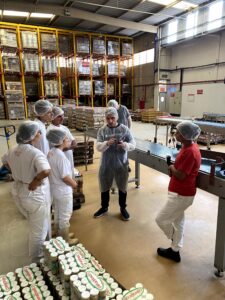
Cogtive team training the Sandéleh team
Continuous monitoring and use of the Cogtive system
To ensure the improvement was effective and enable more refined control, the team used the Cogtive platform’s OEE and Flow View modules. These systems enable real-time analysis of operational data, making it easier to identify stoppages and bottlenecks in the process.
With Flow View, it’s possible to visualize and track how each batch behaves across the different stages of the production line, while OEE provides dashboards and a timeline to assess overall performance. This way, the team can monitor where performance losses are occurring and work directly on the root causes of stoppages.
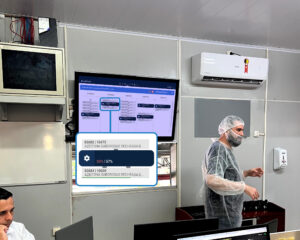
Flow View provides visibility into production stages and how batches behave as they move through the plant.
Decision-making based on reliable data
Implementing these improvements also led to a more efficient decision-making routine. Today, the team holds daily meetings with the participation of the production planning and control (PPC), production, maintenance, and quality departments. These meetings use data generated by the system in real time to identify and solve problems quickly.
Based on the information collected by the Cogtive platform, it became possible to quantify process improvements. One of the most significant examples was the reduction in wait time for a maintenance technician. Before the optimization, that wait was around 15 minutes. Today, it ranges from 3 to 5 minutes — a major gain in maintenance efficiency.
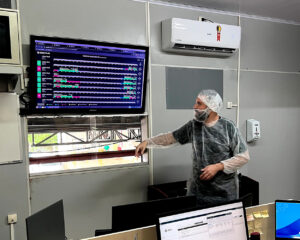
Data can be shared across teams to support decision-making.
Standardizing and stabilizing the process
Another important aspect of the improvement was the standardization of operational processes. The team identified that the speed of the previous conveyor wasn’t aligned with the capacity of the next machine in line, causing inefficiency in the production flow. The Cogtive system helped detect this problem and define a standard speed to optimize the performance of the process as a whole.
Standardization also included setting targets and reviewing how failures were logged. Previously, stoppages were recorded only with information about which part of the machine failed, without specifying the cause of the problem. Now, the failure detected is linked to its actual root cause, enabling a more effective approach to correcting it.
Impact of implementing Cogtive on operational efficiency
Before adopting the Cogtive system, the plant used Excel spreadsheets to track operating efficiency. However, this method didn’t account for all relevant events, such as micro-stops and performance variations, leading to an underestimated OEE. The lack of real-time data made it difficult to analyze and make agile decisions. With Cogtive in place, operational visibility improved significantly. The team began monitoring processes in real time, enabling more assertive decisions and a sharper focus on the process.
It also became possible to standardize production times for each SKU, something that previously varied without control. Another important step forward was understanding and controlling micro-stops. Previously, performance fluctuations went unnoticed, but with the system, it became clear how small interruptions impacted overall efficiency. As a result, it was possible to reduce setup, cleaning, and adjustment times, making the operation more predictable.
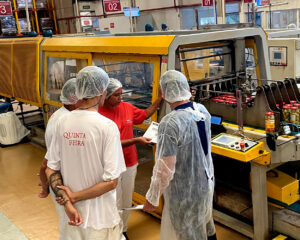
Equipment bottlenecks were identified and resolved with Cogtive’s help.
The results
The impact of the implementation can be seen in the evolution of OEE over the months. In January 2024, the line was operating at just 37% efficiency. With the improvements applied and continuous use of Cogtive, that number rose to 53% in May and reached 66% in September of the same year. This progress demonstrates the effectiveness of a data-driven, continuous-monitoring approach.
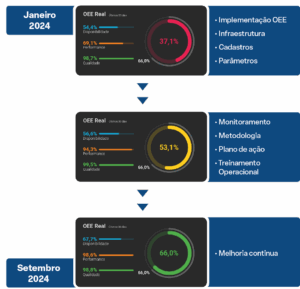
Results were measured over time, proving the gains achieved after implementing the technology.
From this milestone on, the team set a goal to sustain and expand on this improvement. The objective now is to consolidate the gains and pursue new optimization opportunities to further raise the operation’s efficiency. Expanding monitoring, adding new sensors, and continuously training operators are all part of this evolution plan.
Sandéleh after Cogtive
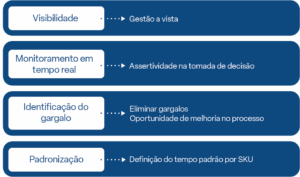
Implementing Cogtive not only brought greater stability and productivity to the production line, but also built a culture of continuous improvement within the organization. With a structured approach and reliable data, the plant continues refining its processes to reach even higher levels of efficiency and competitiveness.